Thursday, September 6, 2012

Birding App Review: Audubon Birds

This is part one in a series of four posts I will be doing about bird field guide apps.  Stay tuned for the reviews of iBird, Peterson, and Sibley apps coming soon.

In the old days (like five years ago) a birder had to rely on only a trusted field guide, his memory, and wits to find and observe birds.  But with the proliferation of smart phones, tablets, and other devices has come a rush of new apps aimed at helping birders identify birds in the field, recognize songs, and even pinpoint on a map the latest sightings in the area.  These digital field guides have quickly become important tools in the birder's repertoire and are a great supplement to the standard field guide.  In this article we will look at four such birding apps that are available today.  We will examine their strengths and weaknesses to help birders decide which app is right for them.  All apps are being tested on an iPod Touch.

We will consider four things when reviewing these apps that will allow us to compare all apps equally.  First we will be looking at the user interface and how easy it is to navigate in the app between elements.  In this section we will also look for any bugs or crashes that may occur.  Second, we will review the quality of the illustrations and/or photographs in each app.  Next we will look at the audio section in each app and review the quality and variation of bird vocalizations.  Lastly, we will look at any extra features the app provides and discuss how this enhances the user's experience.  Let's get started.

   Audubon - $9.99


We will begin with the Audubon Society's app "Audubon Birds".  On the home screen this app gives you a lot of choices on how to begin finding the birds you are looking for.  It allows you to browse by shape, name, taxonomic family, or by search.  The User Interface is clearly marked and is a breeze to use.  When viewing a bird you have the choice of viewing an image, range map, vocalizations, description, similar birds, and more.  The app glides smoothly between elements and there were no issues with freezing or crashes.


This app follows the standard Audubon field guide convention of showing only photographs and no illustrations.  While I find this unacceptable for a hard copy field guide, it works much better in the digital field guide form.  The reason for this is that there are multiple photographs showing different angles and field marks along with differences in ages and sexes.  The static, often poor quality photograph found in the hard copy field guide is replaced with several outstanding high quality and beautiful photographs in the digital field guide and really make bird identification an easier task.  Even better is that for many photographs there is a small button on the photo that you can press that will overlay important field marks and identification tips on top of the photo.  This is a wonderful feature and keeps users from having to flip back and forth between the photo and description to identify their bird.


The audio portion of this app also stands out.  Audubon has vocalizations for every bird and often includes multiple examples of songs, call notes, alarm calls, and other vocalizations.  All audio is clear and easy to hear, making this one of the best apps for bird songs on the market.  One feature that is missing is that there is no way to compare birds with similar songs like there are in other apps.

Audubon really put in time on the extra features this app provides.  They could have left it as a field guide and it would have been a quality app, but the little extras added into the app are the icing on the cake.  The most important feature is the integration with eBird that allows you to view birds that have been seen anywhere in the country.  Just go to the ebird section and you will see a list of birds recently seen in your area.  Clicking on a bird brings up a map with pinpoints showing exactly where the bird was seen and when.  The app also includes a journal where you can keep notes and lists on the birds you've seen, and it also has in depth articles about bird molts and plumage, conservation, natural history, and much more.


In conclusion, this app really stands out for its amazing photography with identification tips, great audio section, and integration with eBird.  There are no illustrations but that is how Audubon guides are usually put together.  The multiple photos and angles makes up for the lack of illustrations in other bird apps.  All in all, I would highly recommend this app for beginning and experienced birders alike.

Thursday, August 30, 2012

Muscatatuck Wild America


Wild America
August can be one of the most difficult months to find wildlife during the day, and afternoon is typically not a good time to find animals.  However, I recently found quite a bit of wildlife at Muscatatuck National Wildlife Refuge in the middle of the afternoon. 

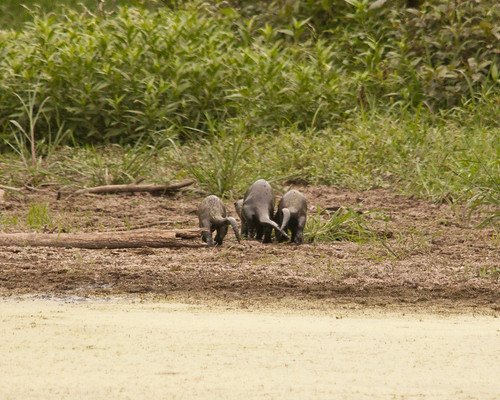
The dry weather had reduced many of the wetlands to small pools, which always seems to have a concentrating effect on watchable wildlife--especially those that feed on the fish and crayfish that are forced into smaller areas of water. On this day I was surprised to find river otters active in the heat of the afternoon. The scene was like something out of a "Wild America" montage.

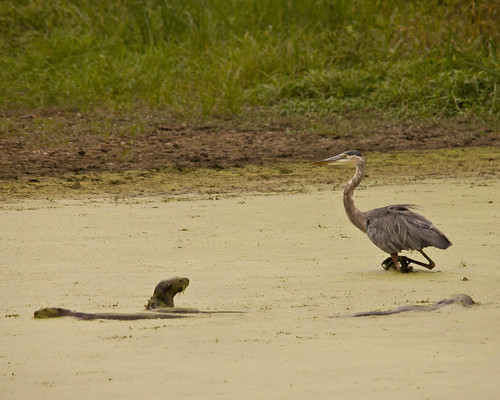
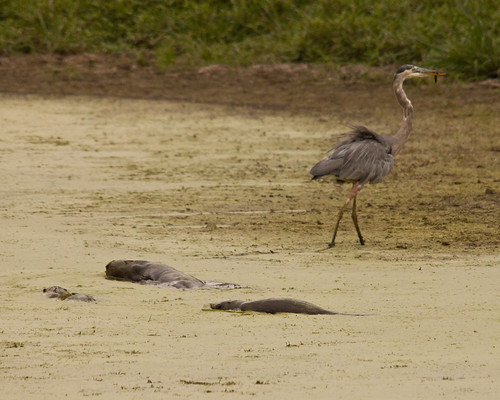
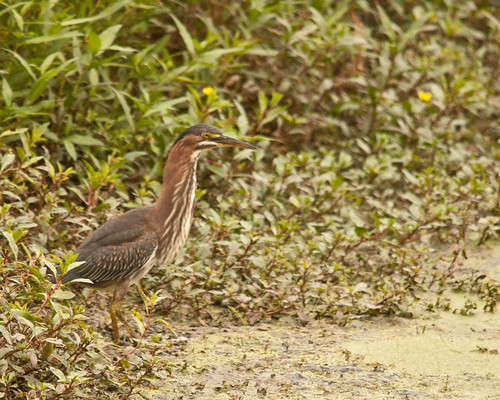
Three otters coated in muck and duckweed rolled in a pool searching for fish, while a great blue heron grabbed fish spooked by the otter's activity.  Half a dozen green herons surrounded the pool--looking nervously and tensing for flight when approached too closely by the otters. 

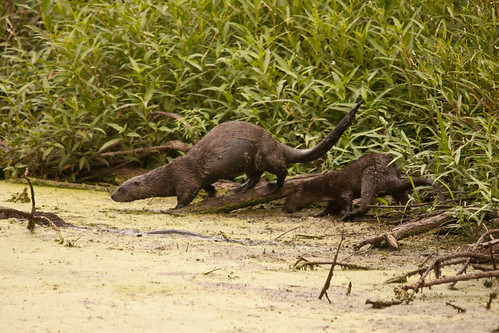
As the muck-slicked otters bounded out of the pool their size difference became more apparent (most likely a mother and two youngsters). Maybe that was the reason for the afternoon fishing trip--hungry teenagers.

  
Parasitic Fisherman
Great blue heron benefiting from fish spooked by the otters.

  river otters
Mother otter and one of her juveniles.

Green Heron
Green heron in a pose that often leads to its misidentification as an American bittern.
 

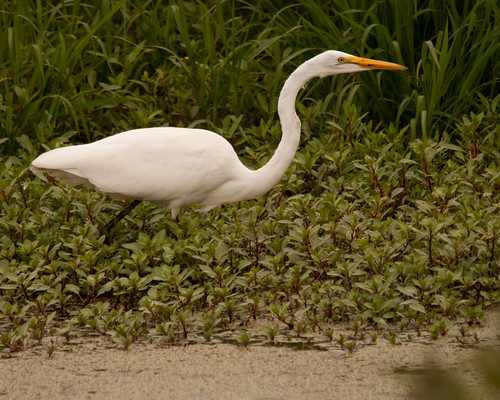
Great Egret Hunting
Great egret stalking the shallows.


The End
The End(s)

Thursday, August 2, 2012

Wood Stork at Anchorage Trail

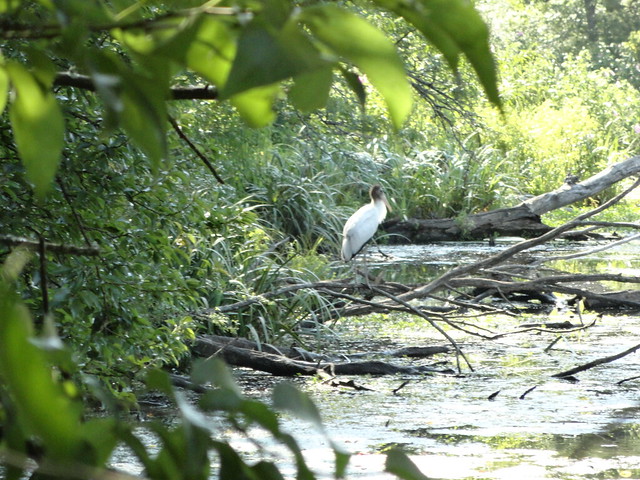
A juvenile Wood Stork was seen at the Anchorage Trail by Jane and Pat Bell on Tuesday and they were kind enough to share the photo below.  These birds are not usual visitors to our area and are most closely associated with the Gulf area.  The bird did not stick around long so congrats to Jane and Pat for a great find.


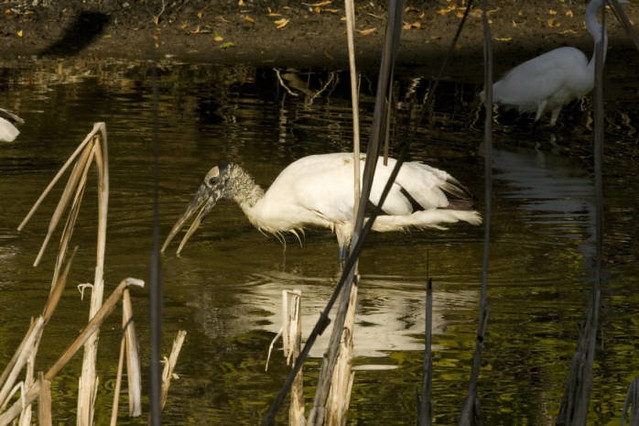
The photo below is from the USFWS and gives a little better look at a Wood Stork. 

Thursday, June 14, 2012

Heartbreaking end to Lake Barkley’s Osprey nest


Sadly, I have to report that the Osprey nest at Lake Barkley has come to an abrupt end due to Great Horned Owls! It was observed on Tuesday morning that one of the chicks was missing. Some of the KEEP (Kentucky Environmental Education projects) volunteers went to the nest site to search the ground, thinking that he may have fallen out of the nest. However, they found no sign of the chick. On Wednesday morning another chick was missing. It was then that Ed Ray, KEEP founder and director feared that a Great Horned Owl was raiding the nest. Unfortunately, this morning the third chick was also gone.

I found myself watching the nest cam more yesterday than before, hoping that by some chance this little guy wouldn’t succumb to the fate of the others! Nest cams are wonderful tools to help us see into the world of birds. It also helps us to understand how much work and effort go into building and keeping a nest, the time that goes into just sitting on the eggs and waiting for the hatching, and finally the work that goes into taking care of the young, defending and protecting the nest. Unfortunately, GHO’s are bigger and much stronger than an Osprey. I’m afraid they wouldn’t have a chance against an Owl! I guess this is where the down side of nest cams comes in. We have a chance to experience the reality that sometimes occurs in the wild. I imagine this kind of thing happens far more often than we can fathom. We are just not aware of it. I think we also tend to humanize the birds that we watch when we are allowed such an intimate look. I personally, am pretty upset about this, but I will accept it and get past it!

The KEEP nest cam has not lost a chick in nine seasons, but with GHO’s involved this could be a recurring problem. Since this is the first season that something like this has happened, KEEP will be working to try to find a solution to this problem. Ed Ray posted an update on BirdKY listserve yesterday. In it he said, “The Osprey platform is about 50 yds. From a mature oak/Hickory forest. The platform was placed where it is, due to this pair of Ospreys attempting to nest just above high voltage power lines. If the platform were removed, the Osprey pair would very likely attempt to nest above the dangerous power lines again.”

Even though this Osprey pairs nesting season is over, let’s continue to keep KEEP in our thoughts and consider donating to them. Ed Ray also informed me that KEEP has donated about 45 all steel platforms, designed to prevent wind damage.  Most are placed mid-lake where they are totally safe from raccoons and GHO’s are not as likely to raid. Each platform costs about $275 for materials (the tall ones with support steel pipes) and all were funded by donations to KEEP. KEEP donates the platforms to KDFWR (KY Department of Fish and Wildlife Resources) and the USCG (United States Coast Guard) for installing whenever requested. KEEP donated six new platforms to KDFWR this spring. To make a donation go to the KEEP website and click on the “donate” button in the top left corner! 

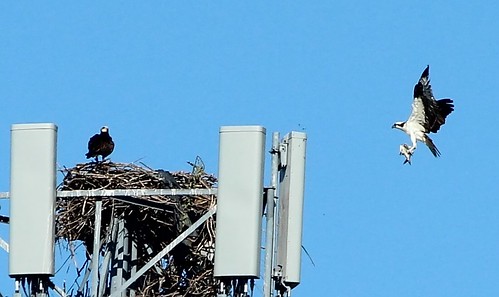
On a more positive note, I went to Shippingport Island today to check on the Louisville Osprey nest. I couldn’t see any chicks yet, but it seems that they do have chicks. Mom looked to be feeding after Dad dropped off a nice sized fish! 

Osprey with dinner

When I first arrived I observed Dad coming back to the nest with a fish, and a third Osprey flying behind him. The third Osprey didn’t go toward the nest, but flew around awhile. Then Dad left the nest and flew around with him. It does make me wonder if there may be another Osprey nest somewhere in the area! I also observed an adult Bald Eagle twice flying around over near their nesting area. 

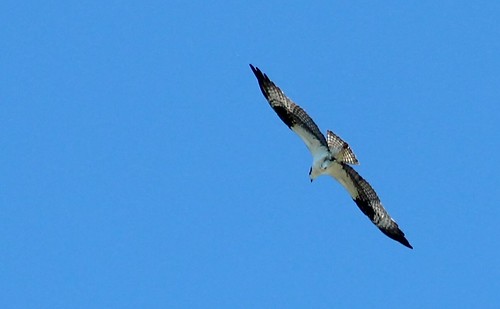
Osprey at Shippingport Island

Friday, May 25, 2012

A Most Wonderful time of the year!


Hello all! I am supposed to be packing for a weekend camping trip to Lake Cumberland, but I had to get a blog post in! It has been such a busy time!
I spent the first few weeks of May trying to hit as many field trips with the Beckham Bird Club as possible! I wanted to share a few of my pics and some links to my smugmug galleries from these field trips.

I joined BBC for a field trip to Black Acre Nature Preserve in Louisville, KY on April 28, 2012.
It was my first time to visit Black Acre and I really liked it, I will be back! Probably, one of the most interesting things I saw on this trip was a Grasshopper Sparrow spotted by our leader Michael Autin!

Grasshopper Sparrow
Grasshopper Sparrow

On April 29, 2012 I went on a field trip to Falls of the Ohio (one of my favorite places) led by Rob Lane! 
We saw many birds at Ashland Park, near Falls of the Ohio State Park! It was deemed a mini fallout! Many warblers, Rose Breasted Grosbeaks, Baltimore and Orchard Orioles! It was a great trip!


Baltimore Oriole (male)
Baltimore Oriole

May 5, 2012 I joined BBC again for a field trip to the Anchorage Trail (another of my favorites) led by Pat and Jane Bell!
This one started out slow, but we ended up seeing several Warblers, Gnatcatchers, Orioles and many other things. We even saw a few Baltimore Oriole nests and a Blue-gray gnatcatcher nest! Pretty cool!

Blue-gray Gnatcatcher, this guy was surprisingly low in the tree!
Blue-gray Gnatcatcher

Indigo Bunting, this one seemed to be posing for me!
Indigo Bunting

The last field trip I visited was to Joe Creason Park/ Beargrass Nature Preserve led by Barbara Woerner! 
 Again, a first for me! Great place! We saw several cool things there, including a Bay-breasted Warbler and Olive-sided Flycatcher, both lifers for me!

This is a skink, but I'm not sure what type
Skink (Travis help me out here, I don't know what kind)

Olive-sided Flycatcher spotted by our leader Barbara!
Olive-sided Flycatcher

Bay-breasted Warbler

Feel free to check out any of my galleries on Smugmug and leave a comment if you like! I have pics on there from our first day in Smoky Mountains National Park! I still have 3 more days of photos to get posted! It was a great trip, we actually saw some Bears this time! 

I also wanted to update you on the various nest cams I have been checking on! 

The KEEP Osprey nest cam  is streaming live now, and they have three chicks that hatched a little more than a week ago! I just love Ospreys! 
The Louisville Osprey nest did not have chicks as of last week, but I expect to have them pretty soon, as I feel that our Ospreys are about a week behind Lake Barkley's! I don't think I will be able to get down there today, since we are leaving for Lake Cumberland this afternoon! I will check on them Tuesday!

The Eagle chicks on the Decorah, Iowa nest cam are now eight weeks old, and jumping around excercising their wings, termed, wingercizing! It never ceases to amaze me how fast birds grow! They will fledge soon! 

The eagle nest in Louisville has one chick that we know of! It was reported on April 16, 2012 by Tom and Colleen Becker. Luckily, the wind was blowing just enough to allow them a view of the nest through the leaves. Reportedly, there were two eggs in the nest! We will just have to wait to see them after fledging, since the leaves are so thick! 

Here at my house, we have seen our first brood of House Sparrows and Starlings! I know neither are native, but the babies are so cute and fun to watch! I got a birdbath for my birthday and the baby Starlings are loving it!


Hopefully, I will have some good sightings to report from Lake Cumberland! Enjoy your Memorial Weekend! 


Sunday, May 13, 2012

"Blue" Bird

Birds as we all know come in a great variety of colors, which is probably why we are so fascinated by them.  From the browns and grays of sparrows, to the bright yellows and reds of goldfinches and cardinals, to the stunning blue hues of buntings and grosbeaks.  While there are a great many birds that exhibit brown plumage, fewer exhibit yellows and reds, and fewer still exhibit blue feathers.  What makes blue plumage so different that it only occurs in a handful of birds?  Before we get in to what makes them so special we have to understand a little bit more about how other birds derive their color.

Many bird feathers achieve their brown coloration from a pigment known as melanin.  Melanin determines the coloration of one's skin or feathers.  The more melanin present the darker the pigment will be.  In fact albinism is just the absence of melanin.  But what does is mean to birds?  In birds melanin can be more than just for coloration.  It is theorized that melanin can be used by male birds to exert dominance over other males.  The dark coloration of feathers is used as a signal that conveys fitness and superiority over other males, reducing the need for fighting among male species in some birds.  Melanin also provides extra strength for bird feathers.  Feathers that contain melanin are stronger and more resistant to wear and tear.  In fact, many white birds have black on their wingtips to reduce the wear on the most important flight feathers.

Song Sparrow
Song Sparrow

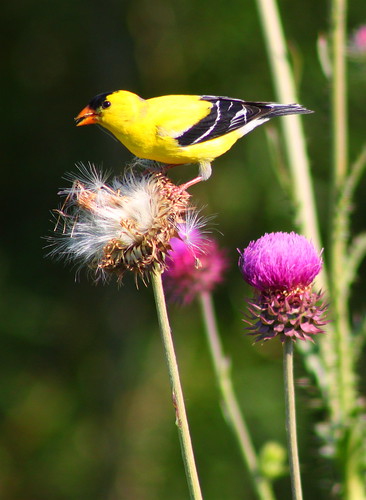
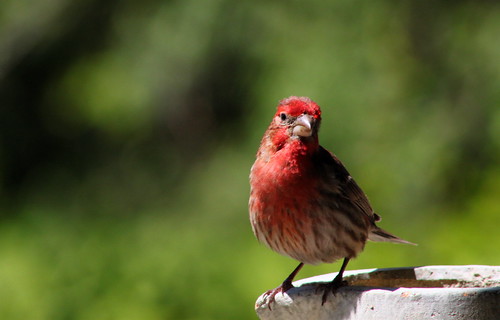
Another form of pigmentation in birds is derived from carotenoids.  Caretonoids are responsible for the yellow and red colors seen in a variety of birds.  Carotenoids are derived from the plants in the bird's diet and are used as a way for female birds to gauge fitness in males.  Females will choose the males that have the brightest coloration because of what it says about the male's genetics and fitness.  Bright male birds are better at foraging, therefore giving them brighter plumage, and making them genetically superior to less colorful males.     

American Goldfinch

House Finch

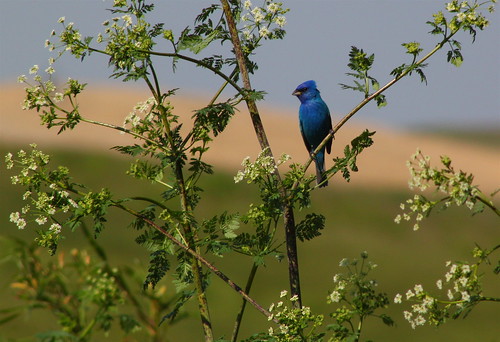
Which brings us to "blue" birds.  Blue feathers are unlike feathers derived from melanin or carotenoids.  Instead of being produced through biophysical methods like melanin or achieved through diet like carotenoids, blue feathers are what is known as structural colors.  Structural colors are produced by the arrangement of the barbules in the feathers to reflect light of a certain wavelength, in this case blue.  So blue feathers are not made by any pigment, rather they are arranged in such a way to trick our eyes into seeing blue.  If you shine a light on a blue feather from behind, what you will see won't be a blue feather, rather it will be brown.  This is because the light source is not hitting it from above and scattering the light to reflect blue color to your eyes.


Indigo Bunting

Structural color is also seen in the gorget of hummingbird species. The gorget is the bright iridescent throat patch that give many hummingbirds their names, like the Ruby-throated Hummingbird.  These birds use structural colors in much the same way, but are different in one respect.  The "blue" birds have structural feathers that include tiny nanoscopic air pockets that interrupt the light and gives the bird an even blue color.  The gorgets of hummingbirds do not contain such air pockets and that is why their feathers give off a bright iridescent shine.  The gorget feathers are much more closely aligned giving the feathers an almost metallic look.

Rufous Hummingbird (photo courtesy of Wikipedia)

Tuesday, May 1, 2012

Happy May Day!

Today is May 1st. As such, it is a French tradition to give a sprig of Lily of the Valley's to your loved ones. Bonne Fête du Muguet my friends!!

  May Day Lily of the Valley

Related Posts Plugin for WordPress, Blogger...

ShareThis


Design by Free WordPress Themes | Bloggerized by Lasantha - Premium Blogger Themes | Walgreens Printable Coupons