Showing posts with label American Goldfinch. Show all posts
Tuesday, November 6, 2012
Sunday, May 13, 2012
"Blue" Bird
Birds as we all know come in a great variety of colors, which is probably why we are so fascinated by them. From the browns and grays of sparrows, to the bright yellows and reds of goldfinches and cardinals, to the stunning blue hues of buntings and grosbeaks. While there are a great many birds that exhibit brown plumage, fewer exhibit yellows and reds, and fewer still exhibit blue feathers. What makes blue plumage so different that it only occurs in a handful of birds? Before we get in to what makes them so special we have to understand a little bit more about how other birds derive their color.
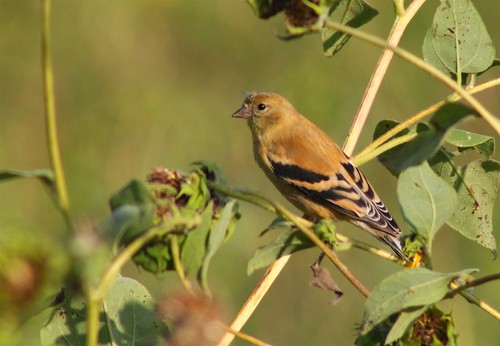
Many bird feathers achieve their brown coloration from a pigment known as melanin. Melanin determines the coloration of one's skin or feathers. The more melanin present the darker the pigment will be. In fact albinism is just the absence of melanin. But what does is mean to birds? In birds melanin can be more than just for coloration. It is theorized that melanin can be used by male birds to exert dominance over other males. The dark coloration of feathers is used as a signal that conveys fitness and superiority over other males, reducing the need for fighting among male species in some birds. Melanin also provides extra strength for bird feathers. Feathers that contain melanin are stronger and more resistant to wear and tear. In fact, many white birds have black on their wingtips to reduce the wear on the most important flight feathers.
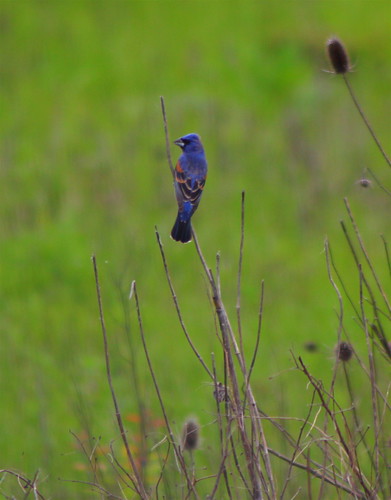
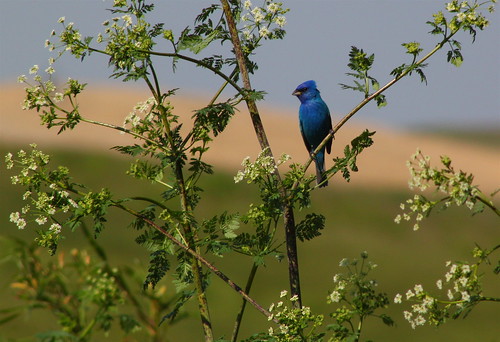
Which brings us to "blue" birds. Blue feathers are unlike feathers derived from melanin or carotenoids. Instead of being produced through biophysical methods like melanin or achieved through diet like carotenoids, blue feathers are what is known as structural colors. Structural colors are produced by the arrangement of the barbules in the feathers to reflect light of a certain wavelength, in this case blue. So blue feathers are not made by any pigment, rather they are arranged in such a way to trick our eyes into seeing blue. If you shine a light on a blue feather from behind, what you will see won't be a blue feather, rather it will be brown. This is because the light source is not hitting it from above and scattering the light to reflect blue color to your eyes.
Structural color is also seen in the gorget of hummingbird species. The gorget is the bright iridescent throat patch that give many hummingbirds their names, like the Ruby-throated Hummingbird. These birds use structural colors in much the same way, but are different in one respect. The "blue" birds have structural feathers that include tiny nanoscopic air pockets that interrupt the light and gives the bird an even blue color. The gorgets of hummingbirds do not contain such air pockets and that is why their feathers give off a bright iridescent shine. The gorget feathers are much more closely aligned giving the feathers an almost metallic look.
Many bird feathers achieve their brown coloration from a pigment known as melanin. Melanin determines the coloration of one's skin or feathers. The more melanin present the darker the pigment will be. In fact albinism is just the absence of melanin. But what does is mean to birds? In birds melanin can be more than just for coloration. It is theorized that melanin can be used by male birds to exert dominance over other males. The dark coloration of feathers is used as a signal that conveys fitness and superiority over other males, reducing the need for fighting among male species in some birds. Melanin also provides extra strength for bird feathers. Feathers that contain melanin are stronger and more resistant to wear and tear. In fact, many white birds have black on their wingtips to reduce the wear on the most important flight feathers.
Song Sparrow
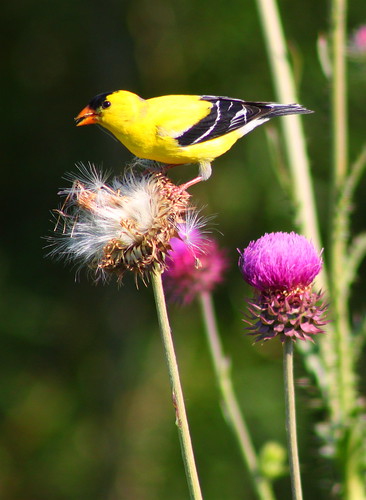
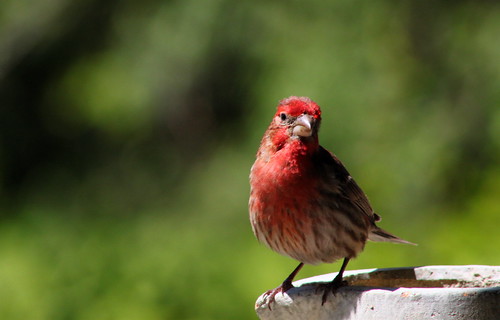
Another form of pigmentation in birds is derived from carotenoids. Caretonoids are responsible for the yellow and red colors seen in a variety of birds. Carotenoids are derived from the plants in the bird's diet and are used as a way for female birds to gauge fitness in males. Females will choose the males that have the brightest coloration because of what it says about the male's genetics and fitness. Bright male birds are better at foraging, therefore giving them brighter plumage, and making them genetically superior to less colorful males.
American Goldfinch
House Finch
Which brings us to "blue" birds. Blue feathers are unlike feathers derived from melanin or carotenoids. Instead of being produced through biophysical methods like melanin or achieved through diet like carotenoids, blue feathers are what is known as structural colors. Structural colors are produced by the arrangement of the barbules in the feathers to reflect light of a certain wavelength, in this case blue. So blue feathers are not made by any pigment, rather they are arranged in such a way to trick our eyes into seeing blue. If you shine a light on a blue feather from behind, what you will see won't be a blue feather, rather it will be brown. This is because the light source is not hitting it from above and scattering the light to reflect blue color to your eyes.
Indigo Bunting
Structural color is also seen in the gorget of hummingbird species. The gorget is the bright iridescent throat patch that give many hummingbirds their names, like the Ruby-throated Hummingbird. These birds use structural colors in much the same way, but are different in one respect. The "blue" birds have structural feathers that include tiny nanoscopic air pockets that interrupt the light and gives the bird an even blue color. The gorgets of hummingbirds do not contain such air pockets and that is why their feathers give off a bright iridescent shine. The gorget feathers are much more closely aligned giving the feathers an almost metallic look.
Rufous Hummingbird (photo courtesy of Wikipedia)
Thursday, September 29, 2011
American Goldfinches in Louisville
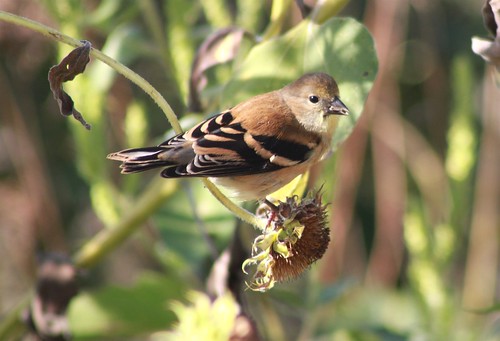
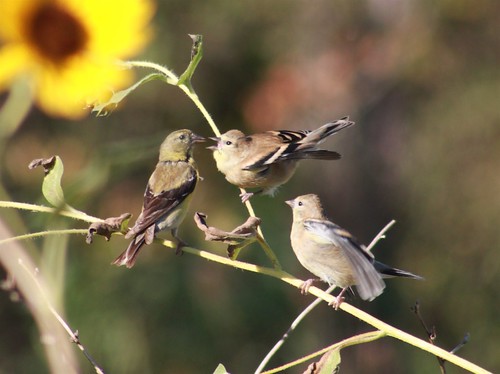
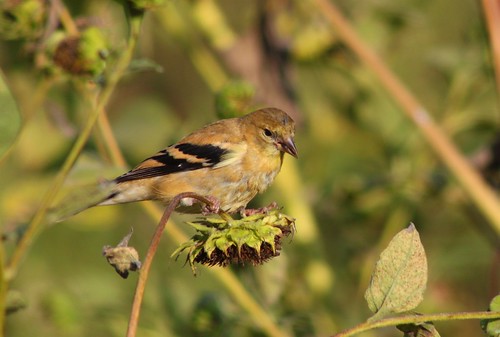
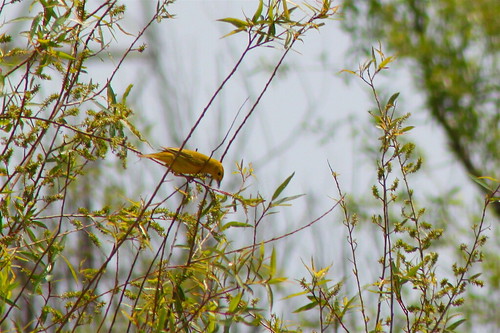
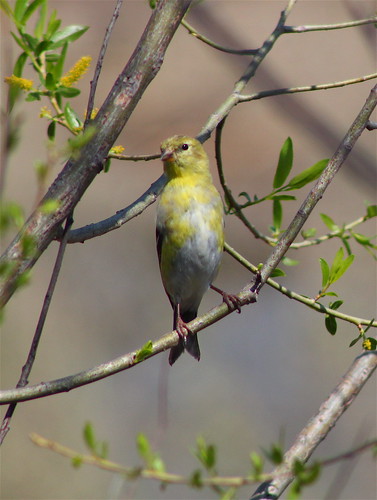
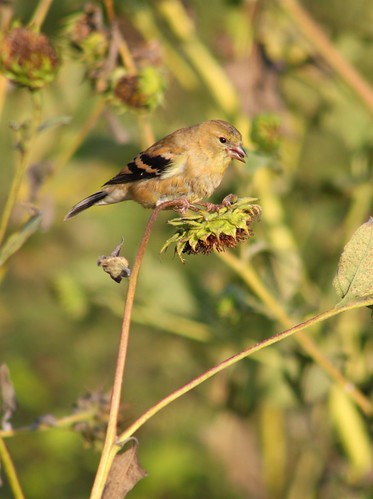
More goldfinches! Most of the Common Sunflowers have gone to seed and these guys are eating them up by the hundreds. As you can see the goldfinches are molting into their winter plumage. Little bits of yellow feathers are hanging on but before long these goldfinches will be much less gold.
Friday, June 24, 2011
A Study in Yellow
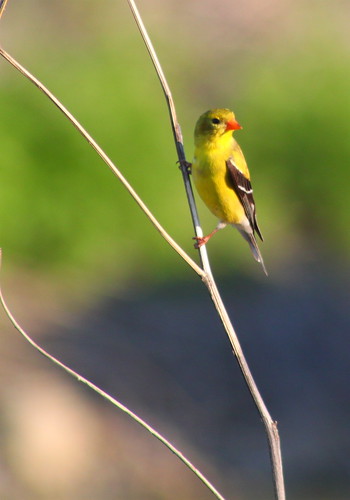
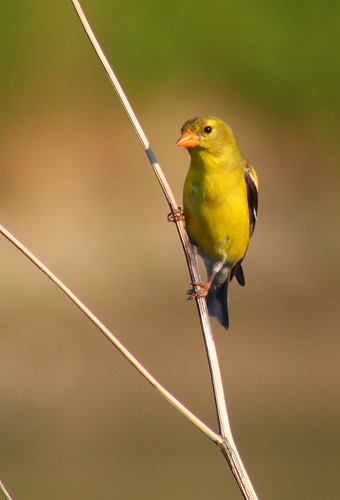
More goldfinches; I told you I had a bunch of pictures. The first two are of the female are my new favorites.
Posted in: American GoldfinchTuesday, June 21, 2011
More Goldfinch Goodness
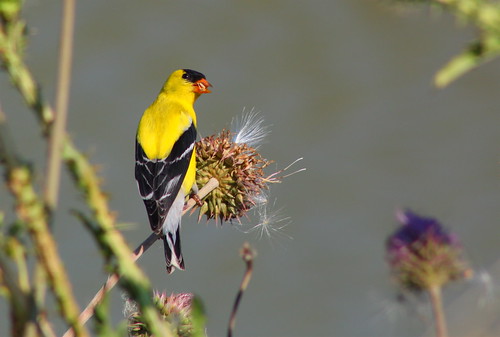
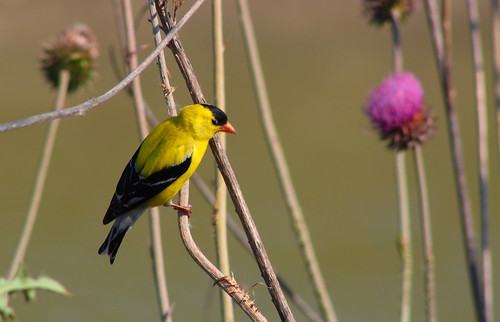
Here are a few of the male American Goldfinches I've been seeing. They are a little more flighty than the females and won't let me get as close for some reason. Videos coming soon so stay tuned!
Posted in: American GoldfinchSunday, June 19, 2011
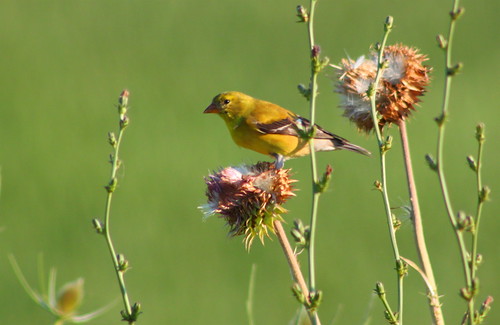
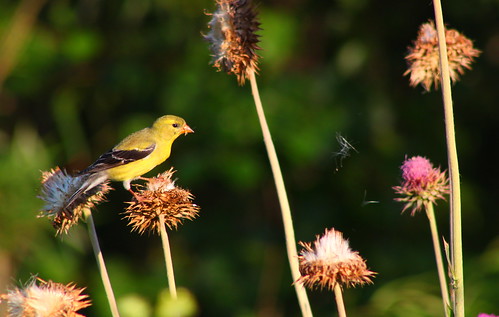
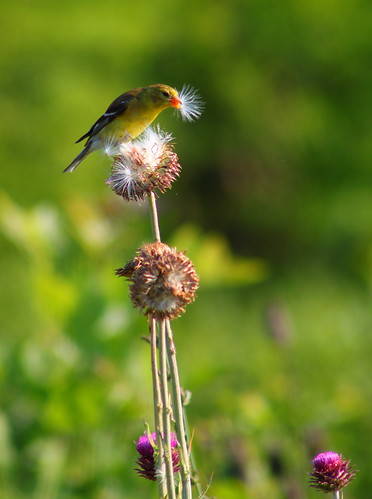
Goldies Love Thistle!
I have quite a few pictures (and videos) I've taken this week of the American Goldfinches attacking the Canada, Bull, and Prairie Thistle. Rather than put all of them up at once I'll spread them out over the week so keep coming back! Here are the first few of the female goldfinches.
Posted in: American GoldfinchTuesday, May 17, 2011
Birdathon: Part One
I counted birds for the 2011 Beckham Bird Club Birdathon this weekend and found a total of 69 species in two days. I planned on doing it all on Saturday the 14th but the weather was looking grim and indeed it was, so I supplemented Saturday's count by counting birds at the landfill on Friday. My goal was to get some good pictures and video to share and I think you will enjoy what I found.
First a little about the Beckham Bird Club Birdathon. The Birdathon is a competition held every year with the goal of raising money for bird conservation, habitat, and education. Last year the Birdathon raised around $14,000 for groups such as Raptor Rehab, Kentucky Natural Lands Trust, and Louisville Nature Center just to name a few.
So let's begin on Friday. In this post I will focus on the birds I saw Friday at the landfill and tomorrow's post will focus on the birds I saw at Floyds Fork Park, McNeely Lake, and my parent's house. There are a lot of good birds at the landfill and they were certainly out Friday night. A few common birds (at the landfill anyway) are below:

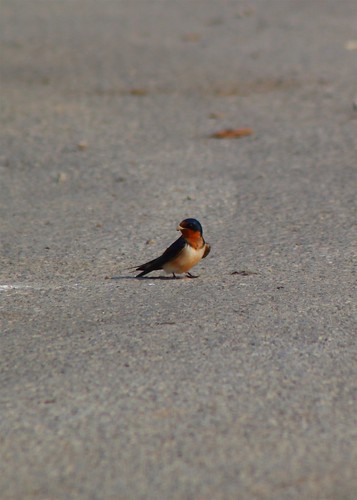
Barn Swallow

There are always several Yellow Warblers singing along the wet ditches at the landfill. A lot of warblers have some yellow on them, but the Yellow Warbler is completely so, only showing some red streaking on the breast and sides in males. The bottom picture is unfortunately out of focus, but you can see the bird is carrying something big and white in its beak and it is a clue that the bird has a nest of chicks nearby. What the bird is carrying is a fecal sac. When the chicks poop the adults must clean it out of the nest. They gather it all up in their beaks and carry it far away from the nest so as not to attract predators.

The light was really nice Friday as you can see in the pictures below.

Northern Cardinal

Gray Catbird

American Goldfinch

Maybe next time he shouldn't be so caught up in his bath because all of a sudden another bird dropped down out of the trees and attacked him. The little oriole was caught unaware and desperately tried to escape as fast as his little wet wings would let him.


All in all it was a good day and I came away with some great pictures (and video) to share. I didn't break it down how many birds were seen each day but the total across both days was 69. I think I could have easily added 10-15 more species if the weather had not been so dreary last weekend. All in all I am happy with what I saw and the pictures I was able to get. Below is a list of all the species seen for both days.
Tomorrow we will look at the birds seen at Floyds Fork Park, McNeely Lake, and my parent's house. Stay tuned!
First a little about the Beckham Bird Club Birdathon. The Birdathon is a competition held every year with the goal of raising money for bird conservation, habitat, and education. Last year the Birdathon raised around $14,000 for groups such as Raptor Rehab, Kentucky Natural Lands Trust, and Louisville Nature Center just to name a few.
So let's begin on Friday. In this post I will focus on the birds I saw Friday at the landfill and tomorrow's post will focus on the birds I saw at Floyds Fork Park, McNeely Lake, and my parent's house. There are a lot of good birds at the landfill and they were certainly out Friday night. A few common birds (at the landfill anyway) are below:
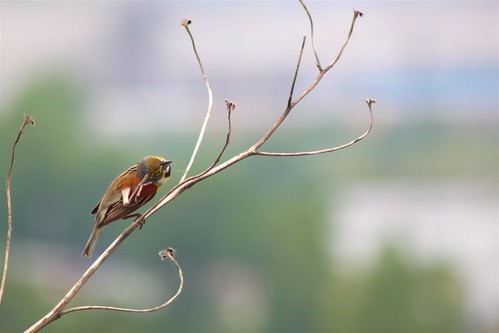
Dickcissel

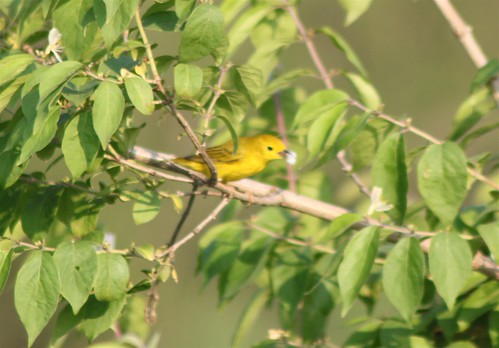
There are always several Yellow Warblers singing along the wet ditches at the landfill. A lot of warblers have some yellow on them, but the Yellow Warbler is completely so, only showing some red streaking on the breast and sides in males. The bottom picture is unfortunately out of focus, but you can see the bird is carrying something big and white in its beak and it is a clue that the bird has a nest of chicks nearby. What the bird is carrying is a fecal sac. When the chicks poop the adults must clean it out of the nest. They gather it all up in their beaks and carry it far away from the nest so as not to attract predators.
The light was really nice Friday as you can see in the pictures below.
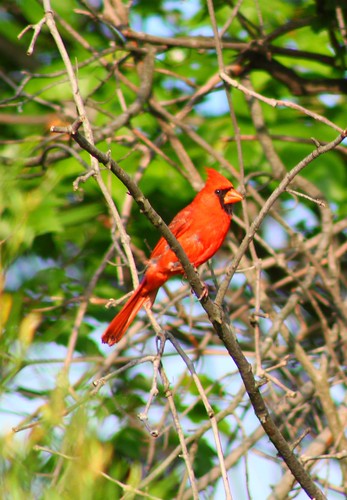
Northern Cardinal
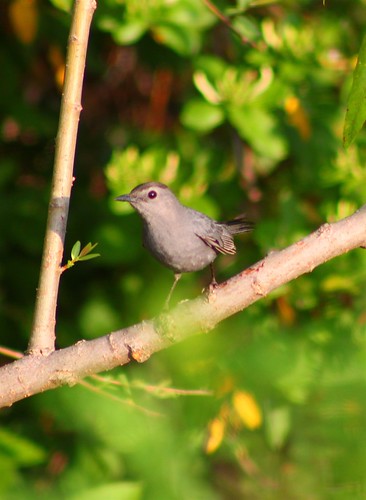
Gray Catbird
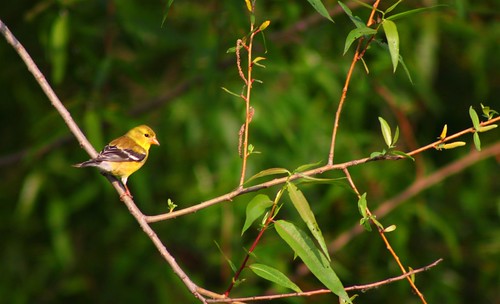
American Goldfinch
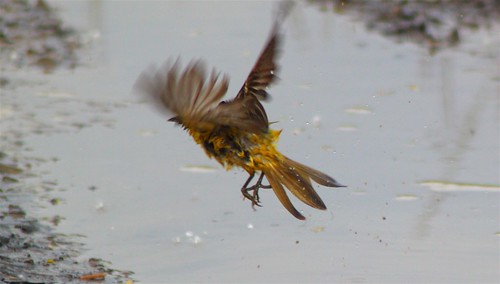
Right before I left I decided to go down a gravel road that runs along a swampy area on the landfill. I'm glad I did because I got to see a neat interaction between two species of birds. I came across an immature Orchard Oriole taking a bath in a puddle in the middle of the road. He was really going at it, splashing around like a kid in a pool. He was so oblivious to everything else that he let me stand right next to him and take several pictures.

Maybe next time he shouldn't be so caught up in his bath because all of a sudden another bird dropped down out of the trees and attacked him. The little oriole was caught unaware and desperately tried to escape as fast as his little wet wings would let him.
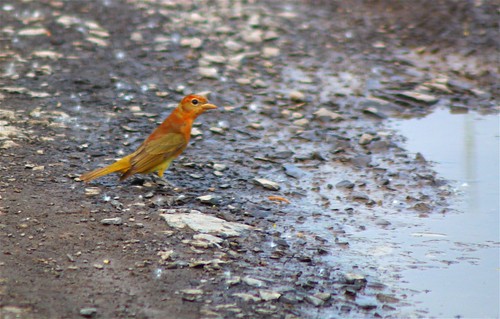
Strangely enough the other bird was an immature Summer Tanager. Adult males are entirely red, but this bird has mottling of green and yellow as well. I think he may have mistaken the Orchard Oriole for another tanager because after he pecked at him a few times he just sat there and looked a bit puzzled, almost as if he was embarrassed for having made a mistake.
All in all it was a good day and I came away with some great pictures (and video) to share. I didn't break it down how many birds were seen each day but the total across both days was 69. I think I could have easily added 10-15 more species if the weather had not been so dreary last weekend. All in all I am happy with what I saw and the pictures I was able to get. Below is a list of all the species seen for both days.
Canada Goose
Wood Duck
Mallard
Black Vulture
Turkey Vulture
Red-tailed Hawk
American Kestrel
Killdeer
Solitary Sandpiper
Mourning Dove
Chimney Swift
Ruby-throated Hummingbird
Belted Kingfisher
Red-bellied Woodpecker
Downy Woodpecker
Hairy Woodpecker
Northern Flicker
Pileated Woodpecker
Eastern Wood-Pewee
Acadian Flycatcher
Alder Flycatcher
Willow Flycatcher
Eastern Phoebe
Great Crested Flycatcher
Eastern Kingbird
White-eyed Vireo
Warbling Vireo
Wood Duck
Mallard
Black Vulture
Turkey Vulture
Red-tailed Hawk
American Kestrel
Killdeer
Solitary Sandpiper
Mourning Dove
Chimney Swift
Ruby-throated Hummingbird
Belted Kingfisher
Red-bellied Woodpecker
Downy Woodpecker
Hairy Woodpecker
Northern Flicker
Pileated Woodpecker
Eastern Wood-Pewee
Acadian Flycatcher
Alder Flycatcher
Willow Flycatcher
Eastern Phoebe
Great Crested Flycatcher
Eastern Kingbird
White-eyed Vireo
Warbling Vireo
Red-eyed Vireo
Blue Jay
American Crow
Blue Jay
American Crow
Northern Rough-winged Swallow
Barn Swallow
Carolina Chickadee
Tufted Titmouse
Carolina Wren
House Wren
Blue-gray Gnatcatcher
Eastern Bluebird
Wood Thrush
American Robin
Gray Catbird
Northern Mockingbird
Brown Thrasher
European Starling
Cedar Waxwing
Northern Parula
Yellow Warbler
Cape May Warbler
Black-throated Green Warbler
Prairie Warbler
Common Yellowthroat
Yellow-breasted Chat
Eastern Towhee
Barn Swallow
Carolina Chickadee
Tufted Titmouse
Carolina Wren
House Wren
Blue-gray Gnatcatcher
Eastern Bluebird
Wood Thrush
American Robin
Gray Catbird
Northern Mockingbird
Brown Thrasher
European Starling
Cedar Waxwing
Northern Parula
Yellow Warbler
Cape May Warbler
Black-throated Green Warbler
Prairie Warbler
Common Yellowthroat
Yellow-breasted Chat
Eastern Towhee
Field Sparrow
Song Sparrow
Summer Tanager
Northern Cardinal
Song Sparrow
Summer Tanager
Northern Cardinal
Blue Grosbeak
Indigo Bunting
Dickcissel
Red-winged Blackbird
Eastern Meadowlark
Common Grackle
Brown-headed Cowbird
Orchard Oriole
Baltimore Oriole
House Finch
American Goldfinch
House SparrowBaltimore Oriole
House Finch
American Goldfinch
Tomorrow we will look at the birds seen at Floyds Fork Park, McNeely Lake, and my parent's house. Stay tuned!
Sunday, May 8, 2011
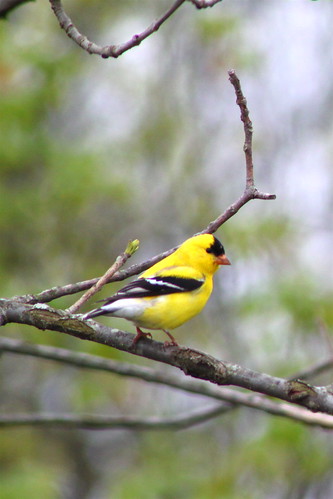
Bird a Day: American Goldfinch
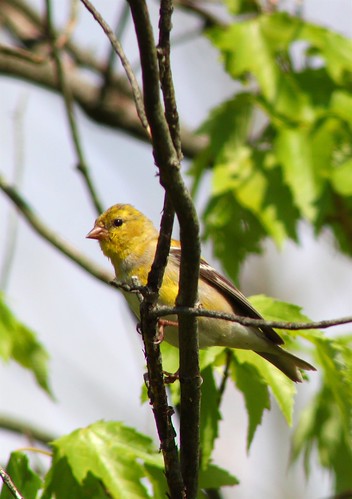
American Goldfinches are native to every state in the country and is the state bird of New Jersey, Washington, and Iowa. They often visit bird feeders, favoring thistle seed the most. These birds are strict vegetarians and rarely eat insects, even in the summer. When they are parasitized by Brown-headed Cowbirds the chicks rarely survive because of the all seed diet the goldfinches feed their chicks. You can find American Goldfinches in almost any type of habitat besides thick forest. They like weedy fields, forest edge, gardens, and suburban yards.
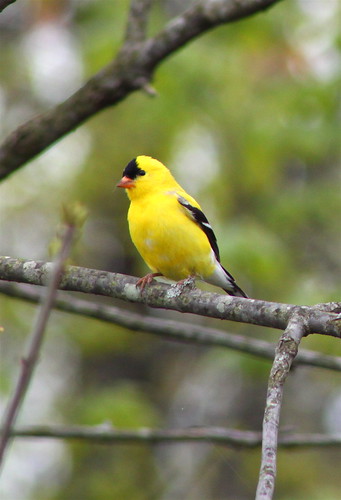
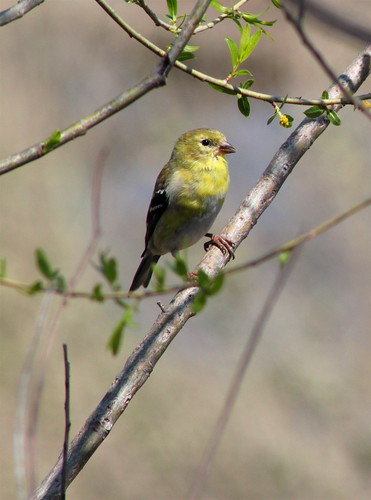
In summer the male goldfinch is a bright yellow with a black cap and wings. The females are yellow but not as bright as the males and lack a black cap. In winter both sexes are plain like the summer female. They are very small birds and often travel in groups, especially near favored food resources like sunflowers and thistles. They have an undulating flight and make a call that sounds like po-ta-to-chip in flight. This is a contact call used to communicate with other finches.
Female American Goldfinch
Male American Goldfinch
Posted in: American GoldfinchWednesday, April 13, 2011
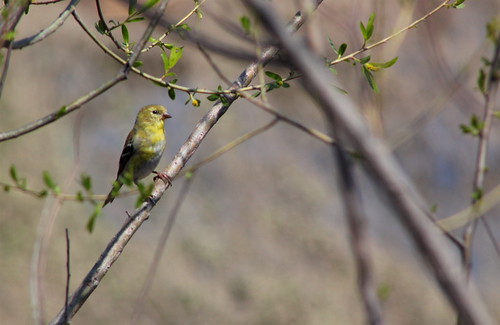
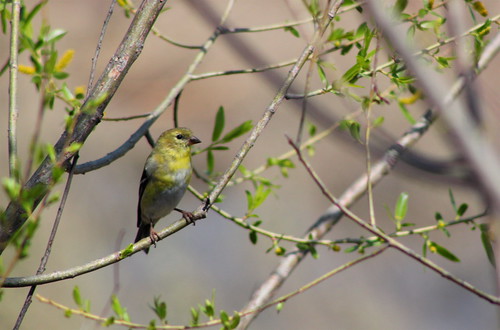
Molting Goldfinch
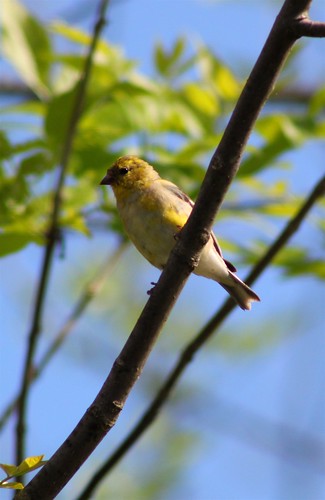
The goldies, as they are so lovingly called, are in the process of molting away their dull winter feathers and are changing into their bright yellow spring garb. I think this is a little female. She was checking me out as I approached some brambles which were likely hiding her nest. The male was singing nearby, close to the same brambles. These little birds are as common as they get, but they are easily one of my favorite birds. Most likely because they are so accommodating when it comes to photographs. :)
Posted in: American Goldfinch
10:21 PM