Hayes Kennedy Park is located on Bass Road, off of River Road, and is operated by metro parks. Directly adjacent to Hayes Kennedy is
Garvin Brown Preserve which is operated by the conservation group River Fields. Check out the map below to see where the parks are in relation to you.
It was another cold and windy day yesterday when we arrived at Hayes Kennedy Park. Being so close to the river made the wind even stronger. There is a little pond, more of a wet depression really, that runs from the parking lot to the end of the park. Usually this little spot is filled with all kinds of ducks but yesterday, in mid January, it was frozen. On the opposite side of the pond the songs of Eastern Meadowlarks can often be heard, but it was too cold and too early in the year to hear them. Blue Jays and Carolina Wrens were calling in the background, and several American Robins were picking at worms on the soccer field. With the pond being frozen and no ducks in sight, we decided to walk the well worn path to Garvin Brown Preserve to see what we could find.
American Robins
Garvin Brown is a special kind of place. It isn't big, only 46 acres, but it has a certain charm. The preserve consists of several fields which are intersecting by paths that run along the edges and cut through the middle. It is often very wet and muddy here, but yesterday the ground was frozen and so was the mud. The preserve is special because it is an oasis of nature along a river crowded by development on both banks. This was the type of habitat that was here before settlers, when the river would occasionally overrun its banks and create this type of early succession fields composed of weeds and grasses.


Today, with the river tightly confined to its banks, mowing is used to keep the fields from growing into forests, and the fields are mowed in a rotational fashion. Rotational mowing is a tool used by wildlife managers to provide several types of habitat in one place. One field is mowed at a time while the others are left to grow wild. Each year a field is left un-mowed the more it changes, new weed and wildflower species grow, and with fields of several different ages a more diverse collection of plants are present. Wildlife enjoy having diverse habitats in close proximity because it allows them to exploit different resources without having to go very far. One recently mowed field may have certain grass seeds birds like to eat, while another older field may have plants that provide nesting material. The goal of rotational mowing is to create as much diversity as possible and to keep the area from becoming a monoculture. Below are some of the plants we found yesterday growing in different fields.


Milkweed Pod
Cocklebur
Goldenrod
An old fence marks the boundary of the preserve. Mega mansions stand on the banks of the Ohio River to the north, but the area directly adjacent to the preserve is an old farm field with a few trees growing tall in the middle of it.
Garvin Brown is visited often by birders because it is a great place to find sparrows and warblers. Yesterday was no exception, though they were camera shy. We saw several species of birds belonging to the Emberizidae family (the sparrows) including: Song Sparrow, American Tree Sparrow, White-throated Sparrow, Eastern Towhee, and a Lincoln's Sparrow that responded to my pishing by bursting into song! It was so clear and beautiful and unexpected. Call me crazy but I swear I heard the song of a Common Yellowthroat as well.
Wich-i-ty, wich-i-ty, wich-i-ty! Alas, I never found the bird making the song, and I'm not brave enough to proclaim hearing a Common Yellowthroat in January without at least getting a picture of it! Below are some of the birds we did see.
 Song Sparrow
 White-throated Sparrow
Eastern Towhee (female)
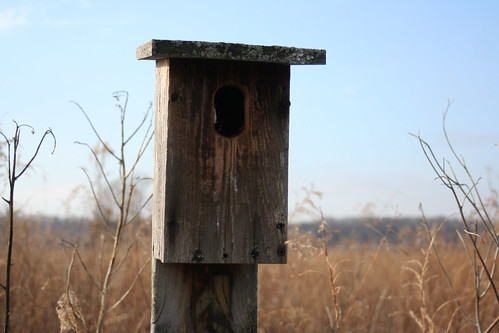
I will definitely be making a trip back in late March. That is when Garvin Brown comes alive. The flowers and trees will be blooming and the birds will be singing. Red-winged Blackbirds show up in force in March, singing for mates and defending territories, but perhaps the most interesting birds in March are the Tree Swallows. There are several Tree Swallow boxes at the preserve that provide nesting sites for these birds. Tree Swallows are very entertaining to watch because of their aerial antics. They swoop and dive and fight in mid air, all for the chance to court a female and raise a brood of birds in an old wooden box. Make it a point to come to Garvin Brown in late March, you will not be disappointed.
Garvin Brown is popular with dog walkers and you are sure to make some friends while you are there.
Before you leave be sure to check out the stairs that lead down to the banks of the Ohio. The shoreline was clean and there were shells and driftwood everywhere. It is a great place to relax and think in solitude, with the sound of the river lapping against the rocks, grass blowing in the breeze, and maybe even a barge or two slowly moving down the river. It makes you wish more of the shoreline of the Ohio River was dedicated to nature.
On the way out we spotted an oriole nest high in a tree. Orioles weave cup-like nests on the ends of branches, making it harder for predators to reach. Just think, only a few more months before the orioles will be back and at it again. I'm really looking forward to spring.


 8:46 PM


 Posted in: