Showing posts with label House Finch. Show all posts

Sunday, May 13, 2012

"Blue" Bird

Birds as we all know come in a great variety of colors, which is probably why we are so fascinated by them.  From the browns and grays of sparrows, to the bright yellows and reds of goldfinches and cardinals, to the stunning blue hues of buntings and grosbeaks.  While there are a great many birds that exhibit brown plumage, fewer exhibit yellows and reds, and fewer still exhibit blue feathers.  What makes blue plumage so different that it only occurs in a handful of birds?  Before we get in to what makes them so special we have to understand a little bit more about how other birds derive their color.

Many bird feathers achieve their brown coloration from a pigment known as melanin.  Melanin determines the coloration of one's skin or feathers.  The more melanin present the darker the pigment will be.  In fact albinism is just the absence of melanin.  But what does is mean to birds?  In birds melanin can be more than just for coloration.  It is theorized that melanin can be used by male birds to exert dominance over other males.  The dark coloration of feathers is used as a signal that conveys fitness and superiority over other males, reducing the need for fighting among male species in some birds.  Melanin also provides extra strength for bird feathers.  Feathers that contain melanin are stronger and more resistant to wear and tear.  In fact, many white birds have black on their wingtips to reduce the wear on the most important flight feathers.

Song Sparrow
Song Sparrow

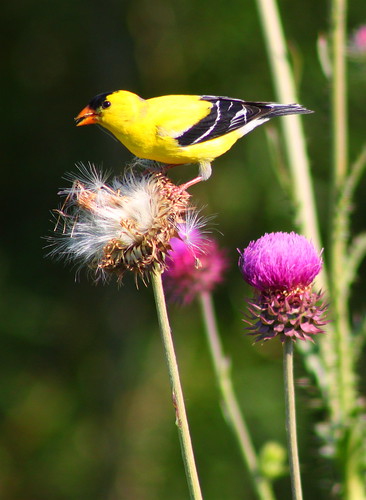
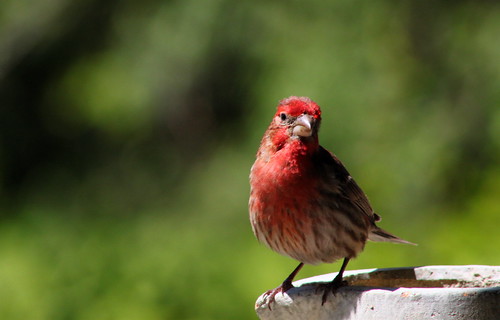
Another form of pigmentation in birds is derived from carotenoids.  Caretonoids are responsible for the yellow and red colors seen in a variety of birds.  Carotenoids are derived from the plants in the bird's diet and are used as a way for female birds to gauge fitness in males.  Females will choose the males that have the brightest coloration because of what it says about the male's genetics and fitness.  Bright male birds are better at foraging, therefore giving them brighter plumage, and making them genetically superior to less colorful males.     

American Goldfinch

House Finch

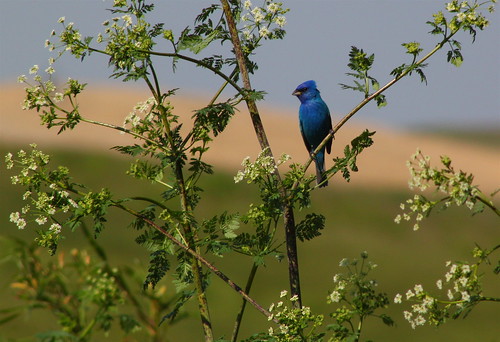
Which brings us to "blue" birds.  Blue feathers are unlike feathers derived from melanin or carotenoids.  Instead of being produced through biophysical methods like melanin or achieved through diet like carotenoids, blue feathers are what is known as structural colors.  Structural colors are produced by the arrangement of the barbules in the feathers to reflect light of a certain wavelength, in this case blue.  So blue feathers are not made by any pigment, rather they are arranged in such a way to trick our eyes into seeing blue.  If you shine a light on a blue feather from behind, what you will see won't be a blue feather, rather it will be brown.  This is because the light source is not hitting it from above and scattering the light to reflect blue color to your eyes.


Indigo Bunting

Structural color is also seen in the gorget of hummingbird species. The gorget is the bright iridescent throat patch that give many hummingbirds their names, like the Ruby-throated Hummingbird.  These birds use structural colors in much the same way, but are different in one respect.  The "blue" birds have structural feathers that include tiny nanoscopic air pockets that interrupt the light and gives the bird an even blue color.  The gorgets of hummingbirds do not contain such air pockets and that is why their feathers give off a bright iridescent shine.  The gorget feathers are much more closely aligned giving the feathers an almost metallic look.

Rufous Hummingbird (photo courtesy of Wikipedia)

Monday, May 23, 2011

Bird a Day: House Finch

I was going to try to avoid the most common birds for my Bird a Day posts, but the bad weather we've been having isn't good for taking pictures so I'll have to use what I have.  This little House Finch male was taken at my parent's house.  This is the male that has a nest on the porch above the outdoor speaker.  My cat was lying near the nest and he came down close to tell her he didn't think that was a good idea.

So, a little about House Finches.  Many people may not know that House Finches are actually an introduced species, in the eastern U.S. anyway.  House Finches historically ranged from Texas to Montana and west to California.  It wasn't until the 1940's when pet finches were turned loose in New York and they quickly spread across the east and have now almost reached as far west as their original range.  They were introduced into Hawaii as well some 70 years earlier and have taken over the Hawaiian Islands as well.  They suffer from a disease known as mycoplasmal conjunctivitis that causes swollen eyes, feather loss, and respiratory problems.  It is thought this disease is so common in House Finches because of the small founding population in the east and with such a small gene pool they are more susceptible to disease.

House Finch

If you want to know what a House Finch looks like, look out your window, there is probably one on your deck or in the trees around your house.  The name House Finch comes from their affinity for nesting around human development.  The males as you can see are a bright strawberry red on the head and most of the body.  They have brown streaking along the sides and breast.  Females lack most of the red and are very plain and also have the streaking on the sides and breast.

Wednesday, May 18, 2011

Birdathon: Part Two

Moving on to part two of the Birdathon posts.  After looking for birds at the landfill I stopped by my parent's to see what they had moving in the trees.  I had been hearing several species of birds singing on their property like Northern Parula, Yellow-throated Warbler, Common Yellowthroat and many more.  By Friday night things had slowed down some and not as many birds were singing.  Perhaps the best bird to be seen was the male Cape May Warbler below.


Cape May Warbler


There were other more common birds making themselves obvious.  This Brown Thrasher was doing just that, thrashing around in the leaves under the neighbors evergreen tree.  I watched him for a while and observed that he was collecting dead sticks and branches.  He was either building or redecorating his nest as he kept coming back for more and more.  He took a break and hopped up on the fence where I was waiting with my camera.


Brown Thrasher

Brown Thrasher


The House Finches were any and everywhere as usual.  There are several pairs breeding on the porch and in the gutters.  They go about their day flying to and from the nest, feeding chicks, and seemingly talking back and forth.  They really come together when the cat is sitting on the porch.  They land within a couple feet of her and scold her for being so close to their nest.

House Finch

House Finch

Saturday wasn't quite as good a day for birding as I was hoping it would be.  I went on the Beckham Bird Club field trip to Floyds Fork Park because it is usually a great trip for seeing warblers and migrants.  Not so much on Saturday.  We heard several species of common birds but seeing them was a different story.  The overcast sky made it almost impossible to take a picture.  Nevertheless we tried anyway.

At the onset we were hearing Eastern Wood Peewee, Prairie Warbler, and White-eyed Vireo from the parking lot.  We had very little luck finding any of them however.  We got a brief glimpse of a Yellow-breasted Chat by the soccer fields.  There used to be a lot of habitat for these birds but it all got mowed several years ago and now there are only a few chats around.  We made it to Floyds Fork and walked down the road that goes along it.  Again we heard much but saw very little.  A Warbling Vireo was singing, as were Alder Flycatcher and Scarlet Tanager.  Towards the end of the road we saw two Great-crested Flycatchers that most likely have a nest in the Sycamore tree.

Finally I had had enough of not seeing any birds so we played back the song of a Prairie Warbler.  The one that was singing nearby zoomed right toward us.  He got real close and gave us good looks, but with the gray sky the picture below was the best I could do.


Prairie Warbler

Prairie Warbler

On the way back to the car, this Eastern Kingbird was flying around the parking lot.  These guys are becoming my favorite birds because they are so photogenic.


Eastern Kingbird
Eastern Kingbird

And at McNeely Lake the Eastern Kingbirds were even more cooperative.  There is a pair nesting in a tree that is standing in the middle of an un-mowed field.  The sun had come out finally and lit this bird up perfectly, making one of the best bird photos I think I have ever taken!

Eastern Kingbird


Before leaving I had to check the lake.  There were several pairs of Mallards and farm ducks.  A beautiful pair of Wood Ducks approached from across the lake and offered some great views (check back tomorrow for pics of those guys).  They didn't have any ducklings following them yet.  Dark clouds were approaching so I did my best trying to capture the swallows flying across the lake snatching up insects.

Barn Swallow

All in all i think it was a successful birdathon. Check out the video below to see some of the footage I got of the various birds. Thanks for stopping by and thanks to those that donated!


Thursday, April 28, 2011

Right at Home

Have you ever been stuck at home, and thought, “I can’t wait to get out of here to go birding”? Well, I’m going to go with the old adage, “Stop and smell the roses”! Sometimes, if we just slow down and take a look around our own yard we can see so many things!

For example, this week I have discovered this little Yellow Rumped Warbler foraging around in a tree in my backyard. I have never seen a Warbler in my yard before!

Yellow Rumped Warbler

Yellow Rumped Warbler

I find House Finches great fun to watch! I have noticed that they will sit at the feeder and break the shells on the blackoil sunflower seed, somehow in their mouth, without ever having to hold it. I haven’t quite figured out how they do it, but it is amazing! I notice Gold Finches do this also.

House Finch
House Finch

They have been pairing up lately! I thought these two were cute, because it looked like they were “playing coy”, not looking at each other! (They were probably just wishing I would mind my own business!)

Playing Coy
House Finches

Here are a few other birds I have seen lately around my yard!

Downey Woodpecker
Downy Woodpecker

Hairy Woodpecker
Hairy Woodpecker

Carolina Wren
Carolina Wren

Cardinal Couple
Northern Cardinals

Tufted Titmouse
Tufted Titmouse

American Robin
American Robin

Mourning Dove
Mourning Dove

Red Tailed Hawk
Red Tailed Hawk

I also find Carolina Chickadees great fun to watch! They flit around constantly and do not make it easy for photographers! I have noticed they will hit the feeder, grab a seed, and dart away to break it open and eat it, usually on a branch!

Two weeks ago this little guy spent quite a bit of time going from car mirror to car mirror, checking himself out! Perhaps it makes him attractive to females if he is attracted to himself! I finally had to back my car into the driveway so the mirror was in my view, then I spent a lot of time sitting on the porch snapping away, believe me I had quite a few blurs!

Carolina Chickadee loving his reflection
Carolina Chickadee

Carolina Chickadee loving his reflection
Carolina Chickadee

This week, I have also noticed a White Throated Sparrow hanging around. I think they should be gone by now, or migrating out pretty soon.

White Throated Sparrow

This one doesn’t have as bright of white on his/her head. I thought maybe it was a female, but my Sibley Guide to Birds says, that adults can range from a tan striped to bright white striped head, regardless of sex!

White Throated Sparrow

Squirrels are always so funny! They love to eat birdseed, suet, and well, just about anything a bird would eat! I constantly find them hanging upside down on the feeders, while eating sunflower seed as fast as they can!

Gray Squirrel
Gray Squirrel

Of Course, it doesn’t always have to be about birds, I have caught sight of some other interesting things around my yard. This is one of the blooms on my Lilac bush.

Lilac Bush Blooms
Lilac Bush

This tree is in my backyard. I haven’t decided exactly what kind of tree it is, but I’m thinking a White Willow. It has pretty little white flowers on it in the spring, that the birds like to eat!

White Willow?


This fungus was growing on another tree. I’m not sure what it is, but thought it was pretty!

Fungus growing on my tree


This guy was sitting on a planter! I again, don’t know what kind of bug he is but I thought he was interesting looking!

Bug


This little Rabbit has lived under a pile of brush for a few years now. I recognize him because of his right ear! I'm thinking he had an incident with a lawn mower!

Rabbit
Rabbit

Go out and take a look around your yard, you may be surprised at what you find!

Friday, April 15, 2011

House Finch

Just a little male House Finch singing at my Mom's.  He and his mate have built a nest on one of the speakers on the porch.  I don't see them having much luck in that spot but you never know, maybe they enjoy listening to The Stones.

House Finch

Related Posts Plugin for WordPress, Blogger...

ShareThis


Design by Free WordPress Themes | Bloggerized by Lasantha - Premium Blogger Themes | Walgreens Printable Coupons